

A cafe can be well run and still depend entirely on one person. In cafe operations, this creates a single point of failure where standards, decisions, and corrections depend on presence rather than systems. It works until the day it has to survive that person stepping back, a key hire leaving, or a second location opening.
Operations is what replaces that dependency. It is the layer of standards, documentation, and accountability that keeps a cafe consistent, whoever is on shift, and it is the line between owning a business and owning a job.
Core Areas of Cafe Operations
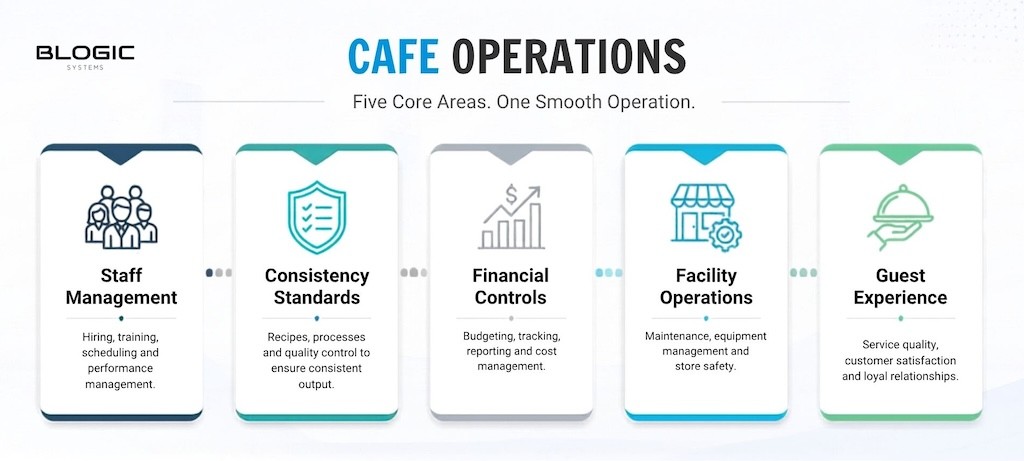
Five areas make up a cafe's operations, and they run at once. Treating them as one system rather than five separate jobs matters because a weakness in one rarely stays where it started.
Staffing and Shift Execution
What makes staffing an operations problem rather than a hiring problem is the standard behind it. A documented standard lets a new barista reach the same result as your best one, and it holds that result on the shifts you are not there to watch. Where the standard lives only in your head, every departure takes a piece of the operation out the door.
Four things put it on paper and keep it there:
Hire for behavioral fit ahead of technical skill; temperament under pressure is harder to coach than the bar.
Train the reasoning behind each standard, so it transfers instead of leaning on the person who set it.
Build the schedule from sales data, staffing each day part according to what it does rather than what last month assumed.
Run a regular, specific feedback loop; standards erode without correction.
Managing a cafe is about keeping standards consistent across every part of the day, from opening to rush hour to closing.
Product Quality and Consistency
Consistency is the clearest test of whether your operation is a system or a personality. Four things hold quality across baristas and shifts: documented recipes, start-of-shift calibration, a menu sized to your weakest shift, and prices reviewed against costs.
Build the menu around your weakest shift. A board that only holds together when your strongest barista is on the floor is a risk every other shift carries.
Price gets reviewed against current ingredient costs at least once a year. A drink sold below its real cost loses money on every order, and the gap widens as suppliers raise theirs.
Financial Controls
Financial controls are where the other four areas show up as numbers, usually a week or more after the cause. The skill is reading a move backward to its source instead of treating it as a finance problem to fix in finance:
When this moves | Look here first |
Labor percentage | A schedule that lagged behind the real traffic |
COGS or a margin line | Over-portioning, or waste that went unlogged |
Voids and discounts | A training gap or a step that no one is following |
Cash variance | A close-out or handling routine without an owner |
Caught the week it appears, each of these points goes back to a specific area while the trail is warm. Left to a monthly review, it surfaces as a pattern long after the fix would have been simple.
Facility and Equipment Maintenance
Equipment maintenance is the area most often run on memory, which is the reason it belongs in the system rather than in someone's head. The failures are quiet before they are visible: a machine off its descaling schedule pulls weaker shots for weeks, and a reach-in two degrees warm overnight is a compliance problem by open.
Four records move it from memory to system:
A maintenance calendar with service dates and who logged them
Cleaning standards assigned by the station and frequency
Daily temperature logs for every cold-storage unit
A renewal and inspection calendar for certifications
Each line slips during the first busy week unless one person owns it.
Guest Experience and Retention
Guest experience becomes an operations question the moment you ask whether a good visit depends on who is working. A queue that backs up during the rush loses the customers who look through the window and keep walking. A complaint that needs you to resolve it loses the guest who would have stayed for a faster fix from whoever was on. A regular who quietly stops coming is worth around two thousand dollars a year, which a retention system notices and a busy floor does not.
A coffee shop rewards program makes that last one a system you run rather than a pattern you hope holds.
How One Gap Spreads to the Rest
The five areas are connected. When one breaks during service, it affects the others immediately.
An opening barista trained without the shift standard builds drinks inconsistently. The bar slows, the queue backs up, and a few customers leave without ordering, revenue that never reaches a report but lands in the week's total. The same barista remakes drinks without logging the voids, so a COGS variance forms that a daily read catches by Friday, and a monthly one catches weeks later as a pattern. Underneath it, the espresso machine that no one descaled is pulling weaker shots the whole time.
One missing standard in staffing reached product, service, and finance within an hour. That is why operations is a system rather than a checklist: you cannot fix the symptom where it shows up, only where it started.
The Role of Technology in Cafe Operations
A system that has to run without you needs one place to store the operation reports, and that is what a POS is. Every transaction, modifier, void, and discount passes through it, which makes it the source for sales by daypart, item movement, and labor against revenue. For a cafe with heavy modifier volume (sizes, milk alternatives, add-ons), its speed and accuracy during the rush are a service issue as much as a back-office one.
Offline capability matters for the same reason. A short internet outage should not stop the morning rush, and a system that keeps taking orders through it absorbs the outage before it reaches the line.
The connected pieces are what let one person oversee what used to take presence. Scheduling is tied to historical sales staff for each day part to its demand. Inventory linked to the POS tracks usage continuously, so coffee shop inventory management flags waste before it becomes a month-end variance. Loyalty built in turns repeat-visit data into a program you can run.
This is where Blogic’s cafe POS system connects daily cafe operations into one system.. It connects counter, table, takeaway, and pickup into a single workflow, while tying ingredient-level inventory, loyalty, and offline continuity into the same operating system. The result is not just reporting, but live operational control across the cafe.
Building Operations That Hold Up Beyond One Location
Everything above is what makes a second location possible or impossible. A single cafe with strong operations has already built the system a second one would run on. The only question expansion asks is whether that system is written down well enough to transfer, or whether it still lives in a few people's heads.
One test settles it: can the first location run at your standard when you are not in it? If it can, you have a system to copy. If it cannot, a second site copies the dependency, and you become the bottleneck in two places.
Oversight changes shape at that point. Drift in a location you are not standing in can run for weeks, so a single dashboard across sites, covering sales, labor, and product mix, does the work the daily walk-through did in one shop.
The finances decide the timing. A second lease taken before the first location reaches healthy cafe profit margins spreads fixed costs across two rents without speeding up profitability. The system has to be documented and profitable in one location before it earns a second.
The through-line holds the whole way down: operations is what you build, so the cafe stops depending on you. Get it right in one location, and a second becomes a question of capital and timing rather than survival.

Erick Tu
Author
Related Articles

Jun 24, 2026
Legal Requirements for a Coffee Shop: The Licenses and Permits You Need

Jun 22, 2026
Coffee Shop Equipment Costs: A First-Timer's Budget Guide

Jun 22, 2026
Coffee Shop Opening and Closing Checklist: A Complete Daily Guide

Jun 12, 2026
Coffee Shop Pricing Strategy: How to Stay Profitable as Costs Rise