
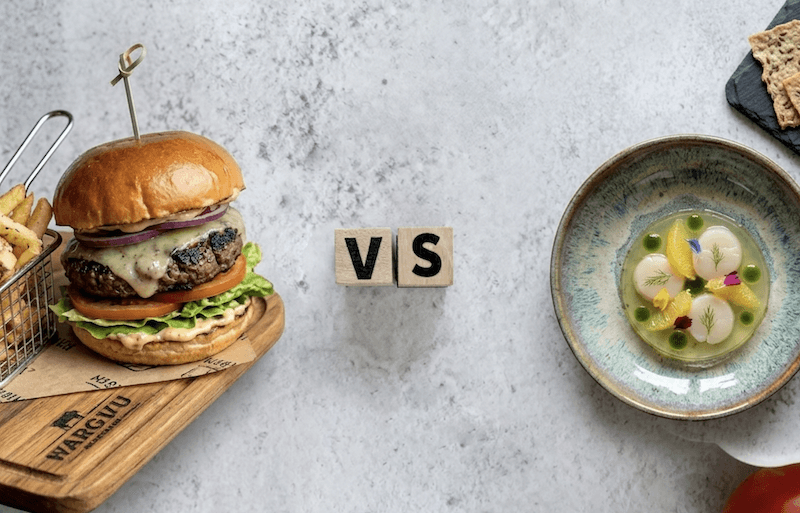
A burger place turning 300 tickets before noon has almost nothing in common with a bistro pacing 90 covers over a dinner service. Same industry, sure. But the kitchen works differently, the team is structured differently, and the way a guest gets their food barely resembles the other.
QSR and FSR split apart in ways that go well beyond the counter vs. table debate. We're talking hiring, kitchen layout, menu strategy, and the tech running behind every shift. If any of those decisions are on your plate right now, the distinction between these two models is worth pulling apart.
What Is a Quick Service Restaurant?
A quick service restaurant is any concept where guests order at the counter, receive their food quickly, and either eat on-site or take it to go. There's no table service. No server stopping by to check on you. You walk up, order, pay, grab your food, and decide whether to sit down or head out.
Most QSRs have a dining area. Some are quite large. But the seating is self-service. You find your own table, bus your own tray, and leave when you're ready. The restaurant isn't managing your experience once the food hits your hands.
Key Operational Features
Counter-based ordering. Whether it's a cashier, a self-order kiosk, or a mobile app, the transaction happens before the food is prepared. There's no one taking your order at a table. This keeps labor requirements per shift lower and the flow predictable.
Menu built for speed and consistency. Fewer items, standardized prep, pre-portioned ingredients. The kitchen is designed around repetition. A tight menu keeps ticket times short, training fast, and food cost easier to control.
Multiple revenue channels running simultaneously. Dine-in, takeout, drive-thru, delivery, mobile pickup. A busy QSR might be fulfilling orders from five different sources at once. Managing that flow without bottlenecks is one of the biggest operational challenges in the model.
Designed for high turnover, both guests and staff. Guests cycle through quickly, which drives volume. Staff turnover is notoriously high across the QSR segment, so the operation has to function with people who are relatively new. If your system or your processes need weeks of training, something's wrong.
What Is a Full-Service Restaurant?
A full-service restaurant is any concept where guests are seated and attended to by wait staff throughout the meal. The interaction doesn't end at the point of sale. It begins there and continues through every course until the check is closed.
This covers a wide range. A casual neighborhood spot with booths and a lunch crowd operates differently from a fine dining room with a tasting menu. But the common thread is that the restaurant is actively managing the guests' experience from the moment they walk in until they leave.
Key Operational Features
Table service is the foundation. A host seats you. A server greets you, takes your order, coordinates with the kitchen, manages timing between courses, and handles payment. That chain of interactions is what guests are paying for on top of the food itself.
Menus carry more depth and complexity. Dishes are typically cooked to order with more involved preparation. Specials change. Wine and cocktail programs add both revenue opportunity and operational weight. The kitchen has to execute a wider range of items at a higher level of detail.
Staffing is specialized and layered. Hosts, servers, bussers, food runners, bartenders, line cooks, expo. Each role has distinct responsibilities, and the whole thing falls apart when one link breaks. An overwhelmed server doesn't just affect one table. It cascades through the section and into the kitchen.
Revenue is built on check average and retention. Fewer guests come through the door compared to QSR, so each one matters more. Upselling, beverage programs, and repeat visits are where the financial model gets healthy. A strong, regular base can carry a full-service restaurant through slow seasons in ways that volume-dependent models can't.
Differences Between QSR and FSR Service Styles and Workflows
The definitions paint a broad picture, but the real contrast shows up in the day-to-day. How orders move, how staff is structured, what the kitchen prioritizes, and what technology needs to do. Here's where the two models pull apart.
Service Flow and Customer Experience
QSR | FSR | |
Ordering | Counter, kiosk, app, or drive-thru | The server takes the order at the table |
Pace | 3–5 minutes from order to food | 45–90 minutes per table |
Guest control | Guests direct their own experience | Staff manages pacing and timing |
Service failure | Slow speed or order inaccuracy | Poor attention, rushed pacing, long waits |
Primary channel | Often off-premise heavy | Dine-in is the core experience |
In a QSR, the guest journey is linear and self-directed. The restaurant's job is to get accurate food into your hands as fast as possible. When that flow stalls, even briefly, you feel it in the line and in the energy of the room.
FSR service has stages that the staff actively controls. Greeting, drinks, apps, entrées, dessert, check. A well-managed meal feels unhurried even when the restaurant is packed, and that pacing is a skill that separates a good server from someone just taking orders.
Staffing and Labor Structure
QSR staffing is flat and interchangeable. A shift might run with a manager, three line workers, and two cashiers. Roles overlap deliberately. Losing one person mid-shift is manageable because the tasks are straightforward enough to absorb.
FSR staffing is deeper and more specialized. A Friday dinner might need:
1 host
5 servers
2 bussers
1 bartender
4 line cooks
1 expo
Each role depends on the others. If the expo is weak, kitchen timing falls apart. If the host double-seats a section, a server drowns, and two tables have a bad experience. Pre-shift meetings exist for exactly this reason: to cover the 86 list, flag VIPs, and get everyone aligned before the doors open.
The labor cost gap is significant. FSRs run heavier on labor as a percentage of revenue because they need more people with more specialized skills working longer shifts. QSR keeps labor lean by design, which is a big part of why kiosks and automation have gained ground so fast on that side of the industry.
Kitchen Workflow and Order Management
QSR kitchens run on standardization. Each station handles a defined step, ingredients are pre-portioned, and the goal is a target ticket time under five minutes. Think production line, not creative cooking.
FSR kitchens deal with variability. A sauté cook might be working six different dishes with different fire times at once. The expo calls tickets, coordinates stations, and makes sure a four-top's entrées land together instead of staggered over six minutes.
The biggest operational difference is course management. It doesn't exist in QSR, where every order is essentially one course pushed out as fast as possible. In FSR, the kitchen has to pace each table's meal deliberately. Fire the apps, wait for the clear, then fire entrées. Dessert timing depends on a conversation between the server and the kitchen. The entire rhythm is built around controlled pacing, not raw speed.
Technology and Restaurant Systems
What each model needs from its tech stack reflects how differently they operate.
QSR priorities:
Speed at the register with fast-tap menus and combo builders
Kitchen display systems focused on ticket time
Self-order kiosks and digital menu boards synced to the kitchen
Strong delivery platform integration and automated order routing
Real-time dashboards to monitor throughput during peak hours
FSR priorities:
Table maps with reservation management
Seat-level ordering and split check support
Coursing controls and kitchen communication tools
Server-facing features for modifiers, specials, and pairings
Guest-facing tools like QR code menus and pay-at-table
Getting this right matters more than most operators realize. A POS built for counter service won't handle coursing and table management well, and a system designed for full-service dining will slow down a fast-moving QSR line. It's worth looking at solutions configured specifically for your service model. Blogic's quick service restaurant POS is built around speed, multi-channel order flow, and quick staff onboarding, while their full service restaurant POS is set up for table management, coursing controls, and seat-level detail. When the system fits the operation, your staff spends less time working around the technology and more time doing their jobs.
Revenue, Costs, and Profit Margins
QSR | FSR | |
Average check | $8–$15 | $25–$80+ |
Daily covers | 200–600+ | 50–200 |
Food cost | 25–35% | 28–38% |
Labor cost | 20–28% | 30–38% |
Net margin | 6–9% | 3–9% |
QSR margins depend on volume. A slow week at a $10 average check erodes profit fast because there's less room to absorb fixed costs. The upside is that lean labor and simplified operations give QSR a more predictable cost structure when traffic is steady.
FSR margins lean heavily on beverage programs. A cocktail that costs $2.50 to pour and sells for $14 does more for the bottom line than most entrées. Wine by the glass, craft cocktails, and dessert upsells are margin levers that QSR operators simply don't have.
Pricing flexibility also diverges. QSR guests compare options quickly and react to price increases. FSR operators have more room to adjust portions, rotate specials around supplier pricing, or introduce seasonal dishes that carry better margins without the same pushback.
Where This Leaves You
These aren't two versions of the same business. They're fundamentally different operations that demand different thinking at every level, from scheduling to kitchen design to the technology you put in front of your team.
The restaurants that run best share one thing regardless of model: their systems match their reality. The layout supports the menu. The staffing plan fits the service style. The tech supports the workflow instead of adding steps to it. Start with how your restaurant operates during a busy shift and build from there.

Erick Tu
Author
Related Articles

Feb 23, 2026
Cafe vs Restaurant: Operational Differences That Matter
Dec 17, 2025
How to Calculate and Improve Your Restaurant's Table Turnover Rate
Dec 10, 2025
Front of House vs Back of House: Two Sides, One Guest Experience

Dec 10, 2025
Call-In Orders: How to Take Phone Orders in a Restaurant